
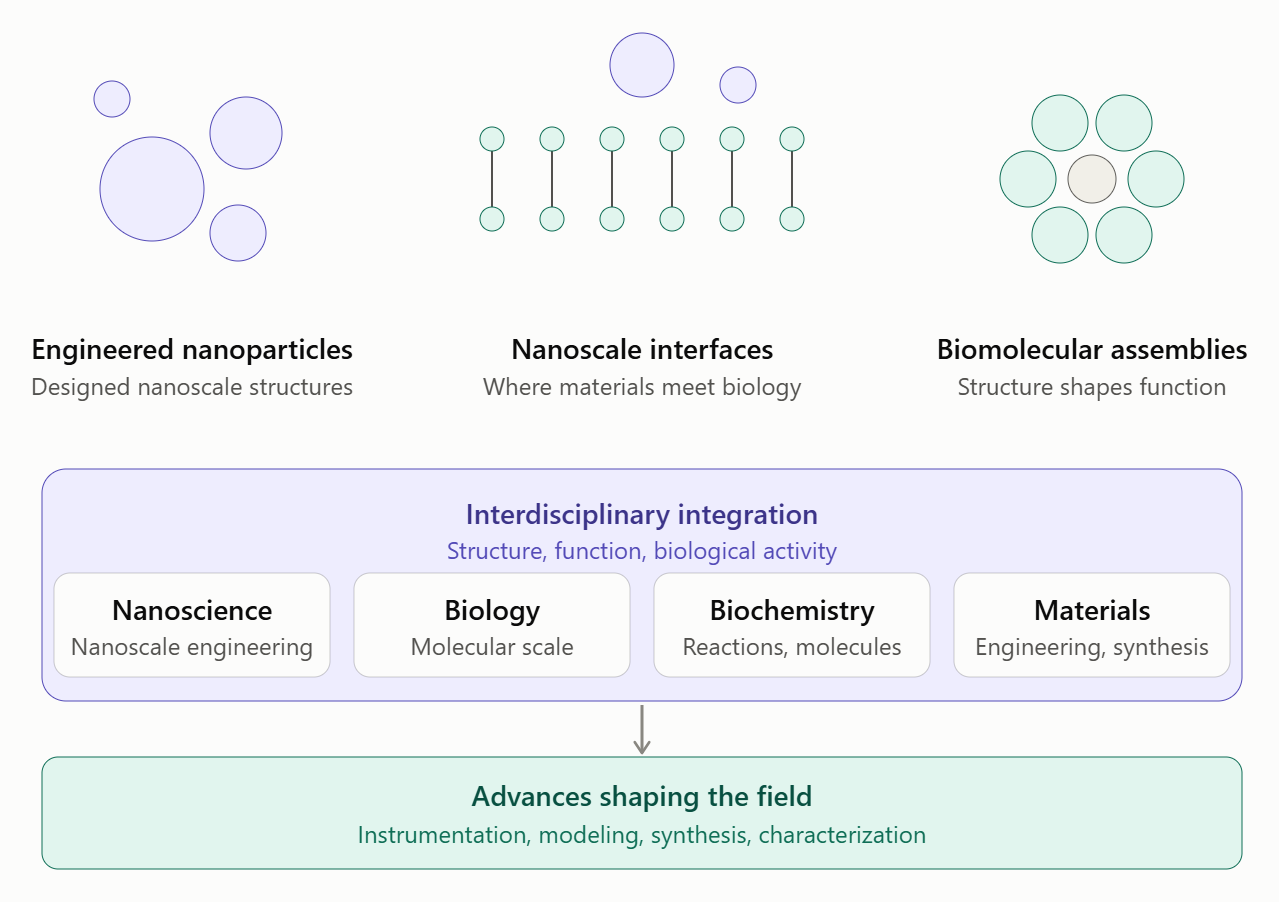
Nanobiotechnology is an evolving scientific field that connects nanoscale engineering with biological research, molecular analysis, and advanced material development. By investigating the interactions between nanoscale structures and living systems, researchers can explore new ways to understand biological organization, characterize complex molecular environments, and develop innovative technologies for scientific applications.
The integration of nanoscience, molecular biology, biochemistry, and materials engineering has expanded the possibilities for studying biological processes at increasingly precise scales. From engineered nanoparticles to biomolecular assemblies and nanoscale interfaces, these research areas provide valuable perspectives on the relationships between structure, function, and biological activity.
Emerging perspectives in nanobiotechnology are shaped by advances in analytical instrumentation, computational modeling, material synthesis, and experimental characterization. Together, these developments are helping scientists investigate increasingly complex biological questions while identifying new opportunities for interdisciplinary research.
1. The Evolution of Nanoscale Biological Research
The development of nanobiotechnology has been supported by improvements in microscopy, molecular characterization, and the controlled fabrication of nanoscale materials. These advances allow researchers to examine structures and interactions that are difficult to investigate using conventional approaches alone.
At the nanoscale, the behavior of a material can differ significantly from its behavior at larger dimensions. Surface area, particle geometry, chemical composition, and interactions with the surrounding environment may influence its physical and biological properties.
These characteristics are particularly relevant when engineered materials interact with proteins, lipids, nucleic acids, cellular membranes, or other biological components. Investigating these relationships helps researchers understand how nanoscale structures behave in complex biological environments.
Modern nanobiotechnology therefore combines fundamental research with the development of methods for producing, measuring, and evaluating materials with carefully defined properties.

2. Nanomaterials and Their Biological Interactions
Nanomaterials represent an important area of investigation because their structural and chemical characteristics can influence interactions with biological systems. Depending on their composition and design, these materials may be studied for molecular transport, biosensing, imaging, biomaterial engineering, and other research applications.
Common categories include polymeric nanoparticles, lipid-based nanostructures, inorganic particles, and hybrid materials that combine different chemical components.
The biological behavior of these structures depends on several parameters, including particle size, morphology, surface charge, chemical functionality, aggregation, and stability. Environmental factors such as pH, ionic strength, and the presence of biological molecules may also affect their properties.
When nanoparticles enter a biological environment, proteins and other molecules can associate with their surfaces, forming an interfacial layer that changes how the material interacts with its surroundings. Understanding this phenomenon is important when evaluating particle identity, stability, and biological responses.
Researchers therefore use complementary analytical methods to investigate both the initial properties of nanomaterials and the changes that occur during exposure to biological conditions.

3. Extracellular Vesicles and Biomolecular Communication
Extracellular vesicles are membrane-enclosed structures released by cells into their surrounding environments. They contain different combinations of proteins, lipids, nucleic acids, and other molecular components, depending on their cellular origin and biological context.
These structures have attracted considerable scientific interest because they participate in processes associated with intercellular communication. Their molecular contents and surface characteristics can provide information about cellular activity and the mechanisms through which biological information is transferred between cells.
Research into extracellular vesicles involves several challenges. Their size distributions can overlap, their molecular compositions are heterogeneous, and biological samples may contain other particles or macromolecular structures that complicate analysis.
Consequently, reliable characterization requires careful sample preparation, appropriate separation procedures, and multiple analytical techniques. Particle measurements alone are generally insufficient to establish vesicle identity or biological function.
Engineered vesicle-inspired systems are also being investigated as platforms for studying molecular transport and biological interfaces. However, their performance depends on factors such as composition, stability, cargo retention, and interactions with target environments.
Continued research in this area may improve understanding of vesicle biology and help clarify the possibilities and limitations of vesicle-based technologies.
4. Molecular Recognition at the Nanoscale
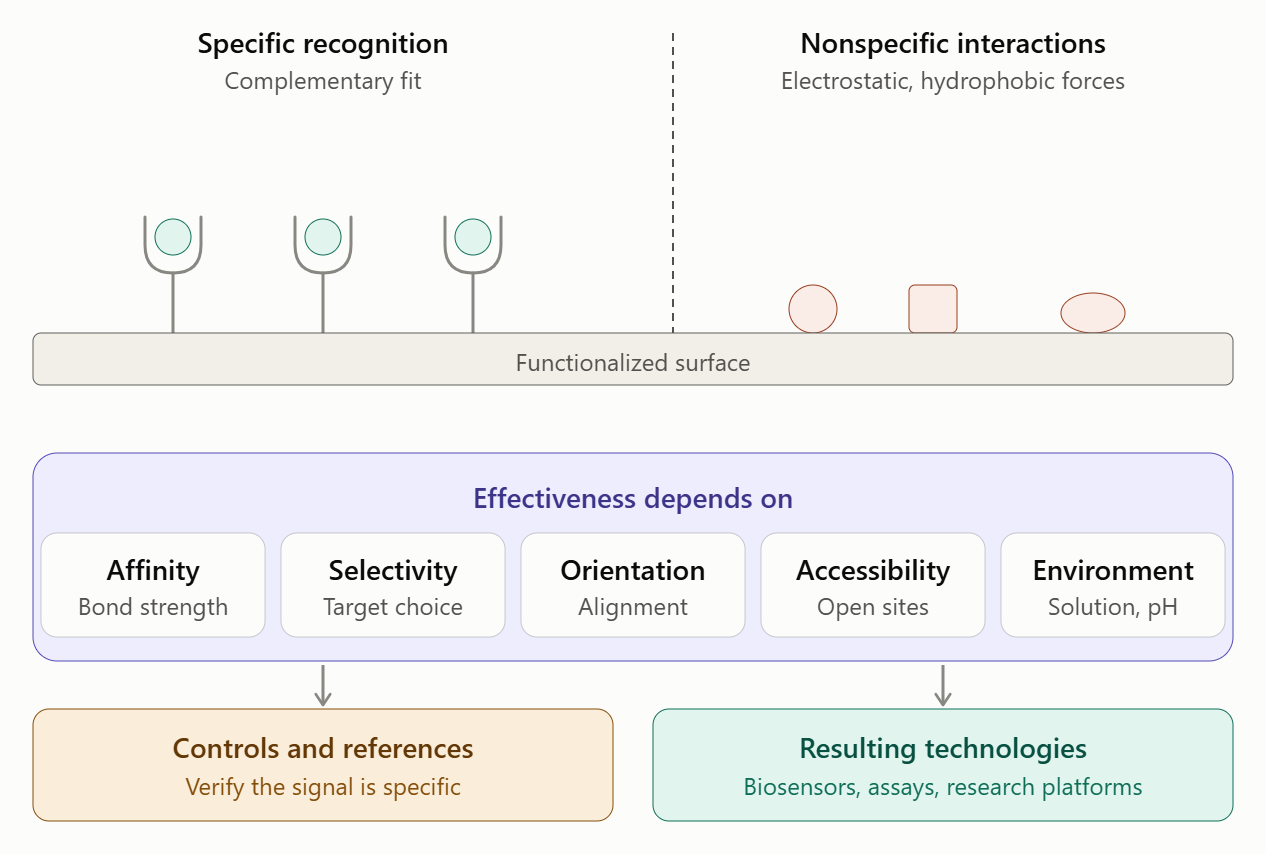
Molecular recognition refers to the selective interaction between molecules through complementary structural, chemical, and physical properties. It is fundamental to numerous biological processes, including enzyme activity, receptor binding, nucleic acid hybridization, and antibody–antigen interactions.
At the nanoscale, molecular recognition can be incorporated into engineered materials to investigate specific interactions or develop analytical platforms. For example, a surface may be functionalized with a recognition molecule that binds a particular biological target.
The effectiveness of such systems depends on several parameters, including binding affinity, selectivity, molecular orientation, accessibility, and the influence of the surrounding environment.
Researchers must also distinguish between specific recognition and nonspecific interactions. Molecules may associate with a surface through electrostatic forces, hydrophobic interactions, or other mechanisms that do not necessarily reflect the intended recognition process.
Experimental controls and appropriate reference measurements are therefore essential for determining whether an observed signal results from a specific molecular interaction.
Advances in molecular recognition technologies are contributing to the development of biosensors, analytical assays, and research platforms for investigating complex biological samples.
5. Nanotechnology in Molecular Delivery Research
Molecular delivery is another important direction in nanobiotechnology. It investigates how biological or chemical compounds can be transported through complex environments and how their stability, distribution, and release are influenced by their surrounding systems.
Different nanoscale platforms are being studied for their capacity to associate with or encapsulate molecular cargo. These include lipid-based particles, polymeric carriers, protein-associated structures, and other engineered assemblies.
The design of a delivery platform requires consideration of particle dimensions, surface characteristics, encapsulation efficiency, release kinetics, and interactions with biological barriers.
For example, the chemical composition of a carrier may influence its stability in a biological fluid, while its surface properties may affect its interaction with cells or extracellular components.
Researchers investigate these properties using a combination of physicochemical characterization, laboratory models, and biological assays. The interpretation of results requires attention to experimental conditions, reproducibility, and the limitations of the selected model.
Although nanoscale delivery systems offer promising research opportunities, their performance must be established for each specific application. Laboratory observations do not independently demonstrate clinical effectiveness or safety.

6. Advanced Characterization Techniques
The accurate characterization of nanobiotechnological systems is essential for understanding their composition, structure, and behavior.
Different analytical techniques provide complementary information. Electron microscopy can reveal morphological characteristics, while dynamic light scattering estimates particle-size distributions in suspension. Spectroscopic methods can provide information about chemical composition and molecular interactions.
Chromatographic techniques may be used to separate molecular components, while mass spectrometry can support the identification and analysis of compounds in complex samples. Depending on the research question, additional methods may be required to investigate surface chemistry, molecular binding, stability, or biological activity.
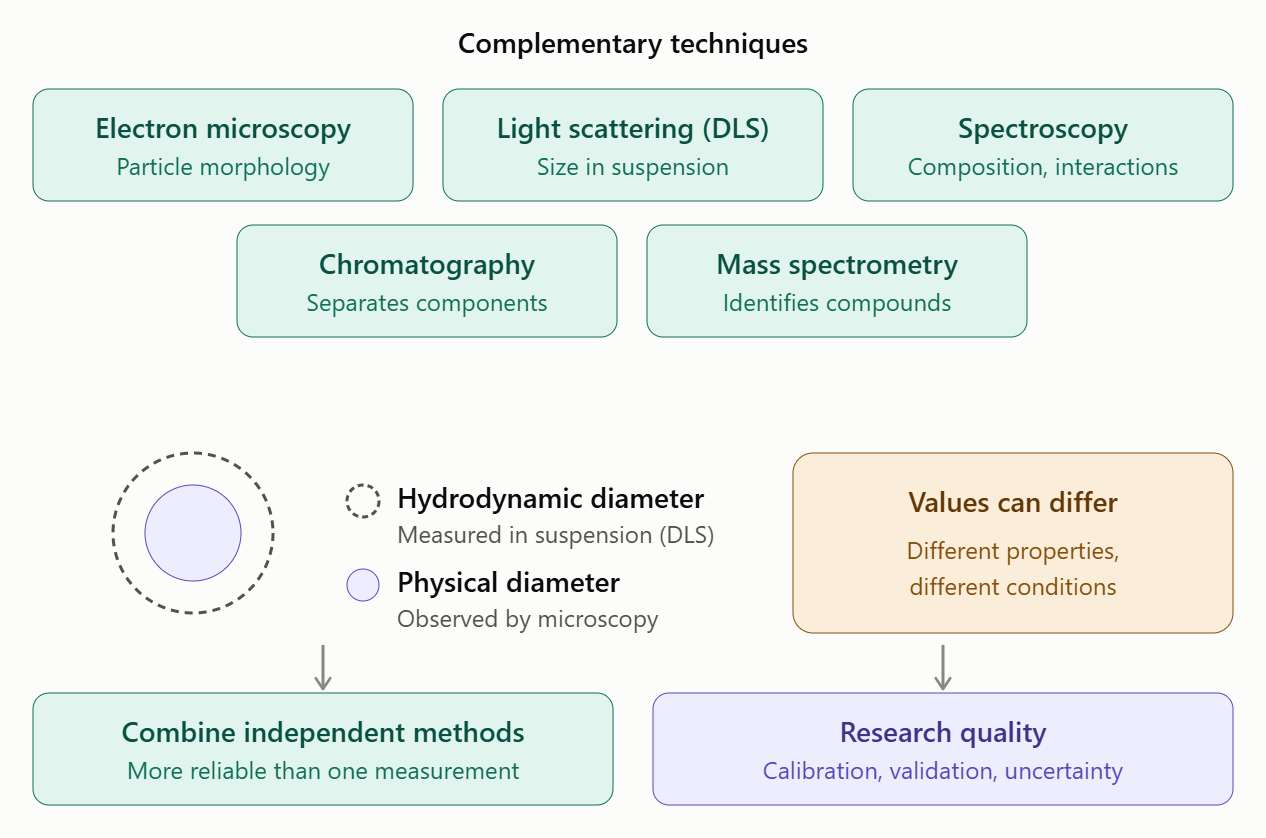
Each technique has specific advantages and limitations. For instance, a measured hydrodynamic diameter may differ from a particle's physical dimensions observed by microscopy. Differences can arise because the techniques measure distinct properties and operate under different conditions.
Combining independent methods can therefore provide a more reliable characterization than relying on a single measurement.
Research quality also depends on appropriate calibration, validated procedures, suitable controls, and transparent reporting of analytical uncertainty.
7. Computational Modeling and Artificial Intelligence
Computational modeling is increasingly integrated into nanobiotechnology to support the investigation of complex molecular systems. Molecular simulations can explore structural organization and intermolecular interactions, while statistical methods can help identify patterns in experimental datasets.
Artificial intelligence and machine learning are also being investigated for tasks such as image analysis, material-property prediction, experimental optimization, and the interpretation of high-dimensional biological data.
These approaches may help researchers prioritize experiments, compare candidate materials, and develop hypotheses about relationships between structural characteristics and observed behavior.
However, the quality of computational predictions depends on the data used to develop and evaluate a model. Limited datasets, biased sampling, inappropriate assumptions, or insufficient external validation can produce misleading conclusions.
Computational results should therefore be interpreted alongside experimental evidence. Their strongest contribution often lies in supporting scientific reasoning and guiding further investigation rather than replacing laboratory characterization.
The combination of experimental nanoscience and computational analysis is expected to remain an important direction for interdisciplinary research.

8. Biosensors and Nanoscale Detection Platforms
Nanobiotechnology also contributes to the development of biosensors designed to detect biological molecules or measure specific interactions. These systems typically combine a recognition component with a mechanism that converts a biological interaction into a measurable signal.
Nanoscale materials may contribute to sensor performance through their surface properties, electrical characteristics, optical behavior, or capacity to support molecular recognition elements.
Researchers investigate a range of sensing approaches, including electrochemical, optical, and fluorescence-based platforms. Each approach has distinct requirements concerning sensitivity, selectivity, sample preparation, and signal interpretation.
An important challenge is ensuring that a sensor performs reliably in complex samples rather than only under highly controlled laboratory conditions. Interfering substances, nonspecific binding, changes in temperature, and sample composition can affect measurements.
Consequently, analytical performance should be evaluated using appropriate controls and validation procedures. Important characteristics include detection limits, measurement precision, reproducibility, and the ability to distinguish the intended target from related substances.
These considerations help establish the scientific value and practical limitations of emerging nanoscale detection technologies.

9. Biocompatibility, Safety, and Environmental Considerations
The interaction between nanomaterials and biological systems requires careful evaluation. A material's behavior depends not only on its intended function but also on its composition, dimensions, surface chemistry, persistence, and potential transformation in biological environments.
Biocompatibility investigations may examine cellular viability, inflammatory responses, oxidative stress, membrane interactions, and other biological endpoints, depending on the material and intended application.
Experimental findings must be interpreted within the context of the model used. Results obtained from isolated cells may not fully predict behavior in complex organisms, and different experimental systems can produce different responses.
Environmental considerations are also relevant. The production, use, degradation, and disposal of nanomaterials may raise questions about their persistence and interactions with ecosystems.
Responsible research therefore includes appropriate risk assessment, transparent reporting, and consideration of the entire material lifecycle where relevant.
These practices support a more complete understanding of nanobiotechnological systems and help researchers identify potential limitations early in the development process.
Future Directions in Nanobiotechnology
Future progress in nanobiotechnology will likely depend on the integration of molecular engineering, advanced characterization, computational analysis, and increasingly sophisticated biological models.
One important direction is the development of more reproducible nanoscale systems with well-defined structural and chemical properties. Improved control over manufacturing and characterization could help researchers compare findings across laboratories and experimental platforms.
Another area of interest is the investigation of dynamic biological interfaces. Rather than treating a nanomaterial as an isolated structure, researchers increasingly examine how its properties evolve after exposure to proteins, membranes, extracellular components, and other environmental factors.
The combination of nanoscale technologies with molecular biology may also improve the investigation of cellular communication, molecular transport, and biological organization.
At the same time, progress will require robust experimental evidence, careful interpretation of computational predictions, and realistic evaluation of technological limitations.
Interdisciplinary collaboration will remain essential because the challenges involved extend across chemistry, physics, materials science, molecular biology, engineering, and biomedical research.